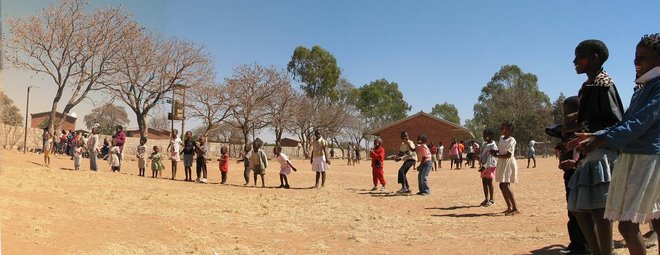
After a wonderful meatball sub & avacados & salad meal with sugar mango pudding for dessert, we couldn't sleep with excitemtn - though we all tried. We were all too excited to sleep. Excited to finally be in Africa and pumped to continue getting to know one another. Already the conversation has started about how we can use our collected gifts to help tell the stories of people we've met already.
Stories of kids here always amaze me. About 150 kids were there for the first day at Aurora Primary School yesterday. Aurora is a K-7 school about 30 min from the airport, set on a beautiful farm. It will be two weeks until they have a better understanding of the count. Kids come from 30 kilometers away, some by foot or bus. We got to meet all the kids informally, in a mass setting while they were playing a game. The energy of screaming kids is always reenergizing. Many don't have parents, or have parents absent or abusive. It was clear that Aurora was a place of healing for some and will be for those that arrived yesterday for the first time.
It is always good to see my friends, the Walkers, who lead Aurora, but especially good. There is so much going on in their lives. Please join me in praying for a house closer to the school, building construction & adjustments underway, and plans to floor classrooms and pay more teachers. Some of ths they don't have funds for, but the are faithful people. We look forward to being ambassadors for them as we return to share their stories.
James rose early this morning to the sounds of birds outside. Rob managed to go back to sleep after awaking. I slept soundly until 15 min before we left for the airport. :) Oops. Just picked up some muffins and OJ at the airport lounge so, Katie, you don't need to worry. We will also eat on the plane. We leave in 50 min for Zambia. Excited to see Remmy again.
Thanks to the Lockwood family for picking us up, feeding us, and housing us. We are so thankful for your love and support. Without your assistance and encouragement - "a welcoming place" - we would not enter Zambia as refreshed as we are this morning.
Lots of love to you all. Thanks for joining us on the journey.
Until Zambia,
Ryan (for James & Rob)
PS if you follow our tweets - but especially for our wives - we wisely decided not to buy Ferraris at the Ferrari store. In fact, we managed to tick off the woman mopping the store. She scowled us out before we could even seriously consider it. :) Alas, another day without ferraris. :)
Showing posts with label HIV/AIDS. Show all posts
Showing posts with label HIV/AIDS. Show all posts
Thursday, January 13, 2011


Thursday, December 16, 2010
Nine Days in Zimbabwe
I have been helping behind the scenes with Forgotten Voices International for several years now. Over five years ago, my friends began describing how God was moving through the dreams of young adults and Zimbabwean pastors. I wanted to be a part of God's movement, so I started volunteering. As the ministry grew, I agreed to take over donation processing and write thank you notes to our amazing supporters. After a few years, my service became more routine. This fall I was given an opportunity to see how my contributions help change lives through the work of Forgotten Voices.
This November, I spent nine days in Zimbabwe. Those nine days will forever change the way I view the work of Forgotten Voices. I met many families that are living in difficult situations: little to no food to eat, no seed to plant and suffering from the effects of HIV/AIDS. This redefined my understanding of difficult.
Since returning, I have been unable to stop thinking about and praying for the Moyo family. Luwazi, his wife and 6 month old twins, Emmanuel and Ethel. They live with five other people in Waybai Village about 8 km from Mtshabezi Mission station. Luwazi is sufferin g from AIDS related illnesses. His wife and Ethel are HIV+, and thankfully Emmanuel is not. The day we met them, they did not have any food to eat and no seed to plant. We talked to them, listened to their story, took pictures and prayed for them. Then we walked away. It was very hard walking away knowing that all we could do was pray for them, but prayer is a powerful thing.
Their story does not end there. The following morning, we met with Pierre, our partner with Foundation for Farming. Forgotten Voices partners with them to provide seed, fertilizer and zero-till farming training to families in southern Africa. We shared with him the stories of Luwazi and the other families that we met the previous day. Before we parted ways, we had a plan for him to provide seed, fertilizer and training for thirty families the following week. So as we were celebrating Thanksgiving, they were preparing their food supply for the rest of the year.
There may be times I may be tempted to slip back into mechanical routines or struggle with screaming kids, but those nine days bring life into perspective. There's real suffering and difficulties in the world, and there is a loving God already preparing a provision for those in need. Last month, God used Pierre, next month it may be you.
Julie Bunch - Volunteer Director of Administration
This November, I spent nine days in Zimbabwe. Those nine days will forever change the way I view the work of Forgotten Voices. I met many families that are living in difficult situations: little to no food to eat, no seed to plant and suffering from the effects of HIV/AIDS. This redefined my understanding of difficult.
Since returning, I have been unable to stop thinking about and praying for the Moyo family. Luwazi, his wife and 6 month old twins, Emmanuel and Ethel. They live with five other people in Waybai Village about 8 km from Mtshabezi Mission station. Luwazi is sufferin
 g from AIDS related illnesses. His wife and Ethel are HIV+, and thankfully Emmanuel is not. The day we met them, they did not have any food to eat and no seed to plant. We talked to them, listened to their story, took pictures and prayed for them. Then we walked away. It was very hard walking away knowing that all we could do was pray for them, but prayer is a powerful thing.
Their story does not end there. The following morning, we met with Pierre, our partner with Foundation for Farming. Forgotten Voices partners with them to provide seed, fertilizer and zero-till farming training to families in southern Africa. We shared with him the stories of Luwazi and the other families that we met the previous day. Before we parted ways, we had a plan for him to provide seed, fertilizer and training for thirty families the following week. So as we were celebrating Thanksgiving, they were preparing their food supply for the rest of the year.
There may be times I may be tempted to slip back into mechanical routines or struggle with screaming kids, but those nine days bring life into perspective. There's real suffering and difficulties in the world, and there is a loving God already preparing a provision for those in need. Last month, God used Pierre, next month it may be you.
Julie Bunch - Volunteer Director of Administration
Friday, December 3, 2010
True Sacrifice
As a “missionary family”, people are often saying thank you to us for the “sacrifice” we make in our work with Forgotten Voices. I am always a little taken back and never know quite what to say in response to this. I do not often think of what we are doing as a sacrifice on our part. Sure, Ryan travels quite a bit and Avery and I are not always able to join him. Sure, he works a lot of nights and weekends, since calling Africa and working with volunteers requires odd hours. Sure, we might be able make a little more money doing something else with our time. But sacrifice? After spending time in Zimbabwe and Zambia and hearing the stories from our partners in Africa, I certainly do not feel like we are sacrificing much.
I have seen first-hand what I would consider true sacrifice. Sacrifice is the grandmother taking in her twelve grandchildren after their parents have passed away due to AIDS related illnesses. Sacrifice is the twelve-year-old who stops going to school so he can work and care for his younger brother and sister. Sacrifice is the home-based care worker who volunteers her time to visit with widows and children who are orphaned. Sacrifice is the pastor who conducts many funerals in one week – week after week. Sacrifice is the pastor who works tirelessly to support his congregants as they work to meet the physical and spiritual needs of the hurting families in their communities. Sacrifice is giving when it would be easier not to – when it would be easier to focus on themselves, but instead focus on the needs of others.
 Sacrifice was Jesus coming to Earth as a man and dying on the cross so that our sins would be forgiven. Christ’s love for us resulted in the ultimate sacrifice, so that we may have life. This leaves us with an incredible responsibility and blessing to honor Christ with our lives. I have learned so much from the pastors, volunteers and families in Zimbabwe and Zambia about what it means to honor Christ with my life through service to others. This Christmas, join our family in praying about how God may be calling us to serve those in our community and in Southern Africa. May we know what it means to truly sacrifice for the sake of others, and as we do, may we learn more about the love of Christ for us and for people all around the world.
Merry Christmas!
Katie Keith
 After spending time in Zimbabwe and Zambia and hearing the stories from our partners in Africa, I certainly do not feel like we are sacrificing much.
I have seen first-hand what I would consider true sacrifice. Sacrifice is the grandmother taking in her twelve grandchildren after their parents have passed away due to AIDS related illnesses. Sacrifice is the twelve-year-old who stops going to school so he can work and care for his younger brother and sister. Sacrifice is the home-based care worker who volunteers her time to visit with widows and children who are orphaned. Sacrifice is the pastor who conducts many funerals in one week – week after week. Sacrifice is the pastor who works tirelessly to support his congregants as they work to meet the physical and spiritual needs of the hurting families in their communities. Sacrifice is giving when it would be easier not to – when it would be easier to focus on themselves, but instead focus on the needs of others.
 Sacrifice was Jesus coming to Earth as a man and dying on the cross so that our sins would be forgiven. Christ’s love for us resulted in the ultimate sacrifice, so that we may have life. This leaves us with an incredible responsibility and blessing to honor Christ with our lives. I have learned so much from the pastors, volunteers and families in Zimbabwe and Zambia about what it means to honor Christ with my life through service to others. This Christmas, join our family in praying about how God may be calling us to serve those in our community and in Southern Africa. May we know what it means to truly sacrifice for the sake of others, and as we do, may we learn more about the love of Christ for us and for people all around the world.
Merry Christmas!
Katie Keith
Monday, November 15, 2010
On to Zambia!
After 6 days in Zimbabwe traversing between multiple project partners including Foundations for Farming, Mtshabezi Secondary School, and The Rock Church among others, the team from Forgotten Voices has moved on to Zambia. You may have noticed from their tweets that the team's schedule has been incredibly busy, a roller coaster ride of mixed emotions as they reunite with old friends and also become reacquainted with their hardships.
Today the team has landed in Ndola to visit the Theological College of Central Africa and meet up with Zambian Program Director, Remmy Hamapande. Leading up to this trip, Remmy had the opportunity to visit the United States for the first time, speaking at numerous events and learning a lot about America culture (and enjoying no small amount of pizza along the way!).

Tomorrow the team will visit Lubuto Church of Christ, an hour and a half drive from their current location in Ndola. Through partnership with Forgotten Voices, Lubuto Church of Christ has been able to send over 80 orphans to school, provide sewing and empowerment projects to 32 widows, and construct a hammer mill for the community.
With the hammer mill in place, the church is now able to generate enough income to sustainably provide for the orphans and widows it currently supports. This project is a powerful example of what successful international partnership can look like, a model that Forgotten Voices is seeking to replicate elsewhere. It's important to note that the ideas for these self-sustaining projects are generated and spearheaded by the local people, as they clearly know what's most needed in their own communities. Forgotten Voices can then act as a conduit for their plans to become a reality.
Please continue to keep the Lubuto Church of Christ in your prayers, as well as our team. May the team's visit provide encouragement to the local community and leadership there as they seek to empower a growing number of orphans and widows across the region.
You can also keep up with the team's journey on facebook as they continue their time in Zambia.
Tuesday, January 12, 2010
Zimbabwe – Final Reflection
The last two days of the trip were dedicated to seeing some of the sights of Zimbabwe – the Hwange National Park and Victoria Falls. Both are amazing in beauty and grand scale. It is hard not to fall in love with a place like this. However, what sticks in my mind is the people of Zimbabwe, who endure hardship that we can only begin to imagine with a dignity and courage that is truly humbling.
Being in Zimbabwe reminded me of 2008 when I had the opportunity to hear John Bell of the Iona Community in Scotland speak to a group here in the US. He told the story of a time when he was charged with doing a story in South Africa for the BBC that took him to a small AIDS treatment center. As a part of the early morning routine in this center, they gathered to pray, sing and dance. After the camera crew got the entire experience on film, John spoke to the woman who ran the clinic. He remarked to her that as he watched this joyful experience unfold that everyone was mixed up, and he could not distinguish the patients from the staff. Her response was that this was the result of an intentional plan, remarking that “For the healthy to be whole, they must be touched by the sick.” In an environment that could be described as hopeless, they had found the secret. In order to be whole persons, those who were healthy and were called to serve needed to touch and be touched by the sick.
As I reflect on my time in Zimbabwe, this observation becomes even more profound. Being there was not only about reaching out to help people in their hour of need. That is the essential work of Forgotten Voices and the reason we are called by God to do this important work. But it was also about how my time with the people of Zimbabwe helps me on the journey to become a whole person.
I hope the stories of Forgotten Voices will touch your heart in a special way so that you will join us as a contributor, prayer partner, or volunteer. But I also pray that the experience of being touched will soften your heart and make you a whole person, able to serve others with kindness and compassion. In many ways we are indebted to the less fortunate of this world as God uses them to make us better human beings. “For the healthy to be whole, they must be touched by the sick.”
Steve Proctor
January 8th Update from Zimbabwe
It was an incredible experience to wake up to the sunrise over the top of the ridge, and to hear the sounds of the animals and little villages coming to life. The beauty of this place is breathtaking.
Today was supposed to be an easy day, but turned out to be as busy as most others since I have been here, with meetings with several groups that we are supporting or hope to support in the future. The Christian Leadership Center is a resource primarily for pastors and lay persons of all denominations. It is a critically needed service, but woefully inadequate. The entire library is smaller than the books normally held by a single pastor in the US, and all 11 computers in the center are old and broken beyond repair.
The lunch meeting with the Ebenezer Trust was the most interesting of the day. We met with Peter Cunningham and Lance and Elizabeth Edwards. It is an impressive program that is focused on teaching people farming skills and launching them in their own business as a farmer. It is two years long, and currently serves 44 students, 75% of them are orphans. It would appear to be the capstone in a continuum of service to orphans in rural areas - a transition to self sufficiency. The combination of farming techniques, business and leadership skills, and faith is a powerful combination to change lives and entire communities.
Later in the day I was reminded again that the reality of death is never far away. When visiting James at the Rock church on the way home, we discovered that his wife’s sister had died the previous day and that he had to drive into Bulawayo to pick up the body and perform the funeral. She was 33, about the average life expectancy for a woman in Zimbabwe. Later in conversation with the Bishop’s office of the BIC church we learned that the Bishop was performing a funeral today and another one tomorrow. What was particularly tragic was that during the funeral there was a car accident on the way to the cemetery, and three of the persons attending the funeral were killed. The result was that in a two day period the Bishop had a total of 5 funerals.
Steve Proctor
January 7th Update From Zimbabwe
We stayed at a guest house near the Mtshabesi Hospital last night. This morning I met a young man staying in one of the other rooms. He is attending a school nearby. When I asked about his family, he told me that his family was well, but his mother some problems getting around and had a pronounced limp. When I asked him about the cause, he said that 12 years ago she was going down to the river to get water, and a crocodile emerged from the water and bit her on the leg. The crocodile was large, and would not let go, and she fought back in the water. The attack lasted about 10 minutes in all, and when his father appeared with a knife, they had the presence of mind to shove the knife down the crocodile’s throat, causing the reptile to release her. Her injuries put her in the hospital for 8 months, but she recovered. I told him that it was a remarkable story, unlike anything I have ever heard. He simply said, “My telling of the story is nothing. You should hear my Mother tell it. She has a powerful testimony, and it is the reason I am a Christian now.”
We visited a family with a daughter severely affected by AIDS. Her legs were weak, and had been contracted. After getting some intensive physical therapy she could now straighten out her legs, but spent most of her day stretched out under a tree. She would be completely immobile except for the walker that was provided by FVI. Her sisters were also in school because of school fees paid by FVI. Again the family was held together by the grandparents. The grandmother seemed very old, and the contrast between her weathered appearance and the 2 year old child on her lap was a reminder of the harsh life these people face, and the toll it exacts on the human body.
The roads we travel to our visits are a real adventure. I am used to bad roads in Honduras, but these are the worst I have ever traveled, sometimes resembling cow paths. Traveling to the Shuma Shamba Lodge involved over 2 hours of a bone jarring ride that left us rather weary. The difficulty of the trip was worth it. The lodge is set in a very picturesque place. Just sitting and watching the nighttime sky is beyond description, with more stars in the sky than I have ever seen, even on the clearest winter night in the US. The term awesome is frequently used in conversation, but the term truly applies here.
Steve Proctor
Jan 6th Update from Zimbabwe
Today we visited Peterson, the little boy whose story has been featured on the FVI website before, and the inspiration for much of the work of Forgotten Voices. His story is a sad one, with the challenges of losing a mother and a sister to AIDS, and being left to live on his own as an orphan with the ravages of the dreaded disease. It is a wonder that he is still alive, and without the support of Forgotten Voices providing medicine and intervening to have him placed with relatives, he would have died several years ago. He is still very frail, and will eventually die of AIDS. In the meantime, he has been granted a life that has its share of joys and childhood playfulness. As a person who likes to fix things, his eventual fate is distressing to me. Seeing him relate to Ryan today is a reminder that providing help even in cases where death casts a dark shadow is work worth doing.
The tour of Mtshabezi hospital was very interesting but less exciting than expected. The hospital census was very low, partially due to the holiday, but mostly due to the fact that they have been without power for the past 3 weeks. It is impossible to imagine running a hospital without a reliable power source, but this is Africa. They have emergency power generators for critical areas, like surgery, but not for the whole hospital. I was surprised by the prevalence of TB, with special holding area for new patients until their TB status is determined. FVI is a significant supporter of the hospital and its outreach program to orphans affected by AIDS.
We also had an opportunity to visit Neatness, who is featured in a video on the FVI web site. While I have seen the video clip many times, she is even more bright and articulate than I expected. She is living with her grandparents who are in their 80’s, a rare occurrence in my observation. Both of them are very engaging individuals. One can see that part of the legacy that they have passed down to her is the gift of a positive spirit. The faith that serves as her source of hope is so real and vibrant that just being around her is uplifting to me. Her hopefulness and optimism in the face of huge barriers is a lesson for all of us who find that the little things of life seem to get us down.
Steve Proctor
Thursday, January 7, 2010
Jan 7th Zimbabwe Update

Another quick update about the team's current travels in Zimbabwe for those following along:
The agenda for today was just as packed as yesterday and included visitation with numerous HIV/AIDS patients in their homes until about midday, then a trip to Matopos to check in with Matopos Primary and Farming God's Way.
If you're not familiar Farming God's Way, the organization is a partner of Forgotten Voices that facilitates about 700 farms which employ over 7,000 local people. Farming God's way continues to make a tremendous impact in the communities it serves, bringing together people of different
 tribes to work peacefully together and provide food for their families. Through innovative farming techniques and sharing of the gospel of Christ, Farming God's way is increasing crop yields and changing lives.
Thanks for following the team's journey thus far, stay tuned for more updates and reports from the team as they become able to connect to the internet and share with us.
-Brian
Subscribe to:
Posts (Atom)


 Posts